
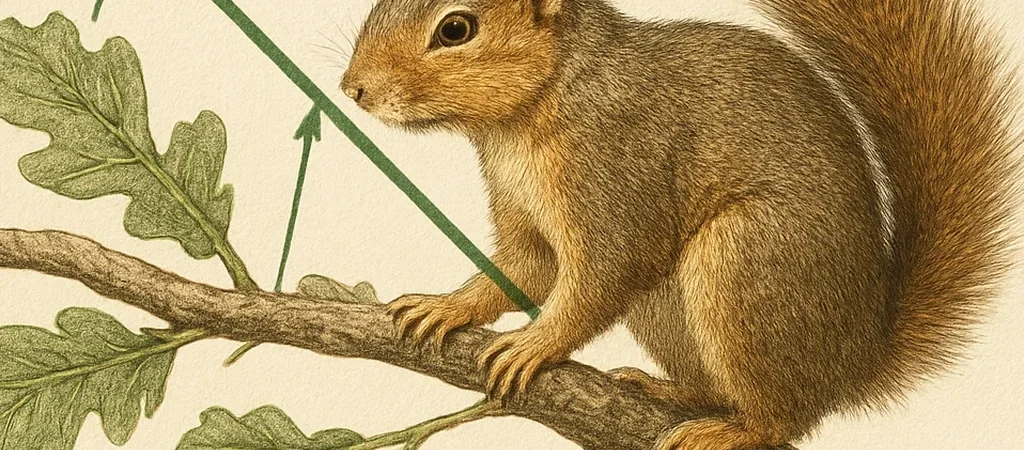
Watching a fox squirrel bound across a high canopy reveals a series of split-second mechanical decisions. Before taking a leap across a three-foot gap between swaying branches, the animal must assess structural stability, wind resistance, and distance. This natural calculation provides an ideal framework for understanding binary search trees and decision logic in computer science. Every leap represents a sequence of conditional evaluations where binary outcomes determine the safest path forward.
Evaluating Branch Flexibility and Leap Trajectories
As a squirrel pauses on a branch tip, it conducts a rapid series of physical tests by shifting its weight and flexing its limbs. In algorithmic terms, this testing phase gathers real-time sensory data to evaluate conditional nodes in a decision tree. If branch flexibility exceeds a safe threshold, the system branches toward an alternative route; if the vector remains stable, the leap is executed. This process directly mirrors the conditional logic that autonomous vehicles use when sensing obstacles and selecting navigational pathways.
Recalculating Routes Under Environmental Stress
When unexpected obstacles arise mid-transit, such as a snapping twig or a sudden gust of wind, the animal must execute instantaneous route recalculations. Rather than restarting its navigational plan from scratch, the squirrel adjusts its trajectory based on adjacent anchor branches. This continuous feedback loop aligns with error-correction algorithms in network routing, where data packets are dynamically rerouted around broken transmission nodes.
By breaking canopy movement into discrete conditional steps, algorithmic thinking becomes an intuitive lens for observing wildlife. STEM learners can easily translate these physical observations into formal flowchart structures and code-based logic trees. Nature solves spatial challenges through real-time feedback, offering a clear model for building adaptable artificial systems.